The three ways to staff a build
Every software build gets staffed one of three ways. You hire someone permanently, you bring in a freelancer for the scope in front of you, or you hand the whole thing to a managed team. Most founders pick based on the first number they see, the salary, the day rate, or the monthly invoice, and work out what it actually cost them six months later.
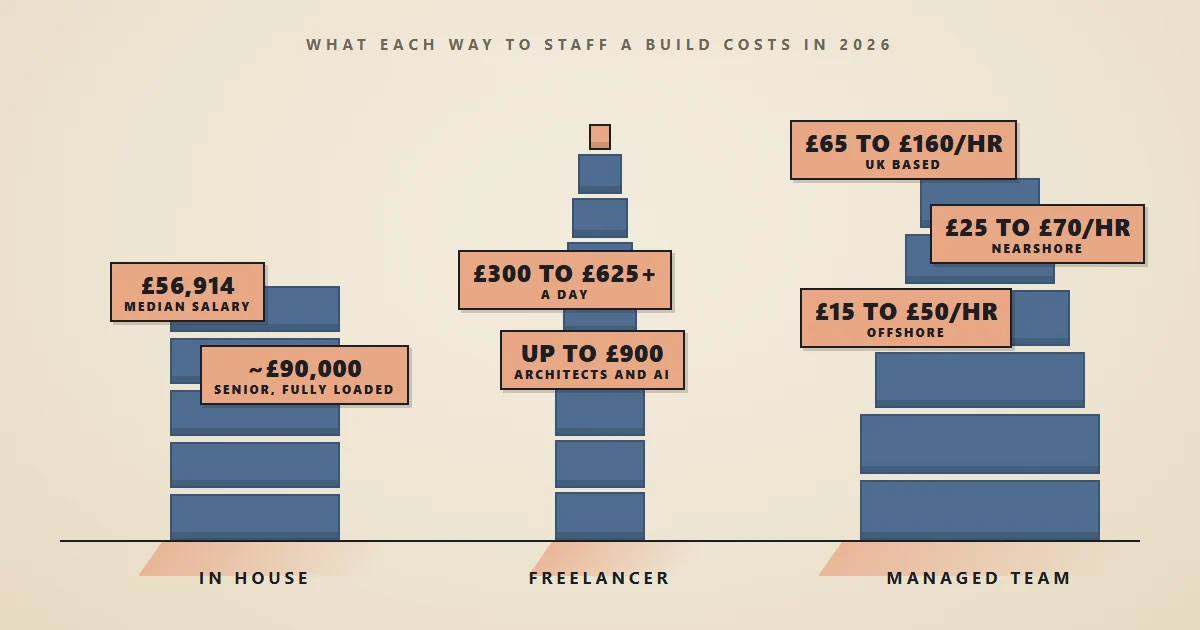
Here is the direct answer. An in house UK developer earns a median salary of £56,914 a year, and a senior hire costs around £90,000 a year once National Insurance, pension, recruitment and equipment are added. A UK freelancer typically costs £40 to £180 an hour, or roughly £300 to £625 or more a day depending on seniority. A managed team costs £65 to £160 an hour if UK based, £25 to £70 if nearshore and £15 to £50 if offshore, depending on team size, location and specialisation.
Three very different numbers, and three very different things you are actually buying. Lost Circle runs delivery as a managed, UK led team, so this comparison is the exact conversation we have with clients before they choose a structure, not just a pricing table.
In house: what the salary line never tells you
For an in house hire, the median full time salary for programmers and software development professionals is £56,914 a year, with the top decile starting at £102,860, according to the Office for National Statistics Annual Survey of Hours and Earnings, 2025 provisional data. That is before employer National Insurance, equipment, recruitment fees and office overhead are added on top. Most founders underestimate that on cost layer by a wide margin, and it is usually the single biggest gap between the number in a job advert and the number that actually leaves the business account.
Base salary is only part of the real number. According to Grove, the fully loaded cost of a UK employee is typically 1.25 to 1.5 times base salary, so overhead adds 25% to 50% on top. On a £50,000 salary, employer National Insurance comes to £6,750 and a 5% pension to £2,500. Agency recruitment fees are charged as a share of first year salary, 20% in Grove’s example. A laptop and peripherals cost £1,500 to £3,000, software licences £800 to £2,000 a year, and a desk £3,000 to £6,000 a year outside London or £6,000 to £12,000 in London. Red Eagle Tech puts the fully loaded cost of a senior hire at around £90,000 a year, and DataVolve’s calculator is a quick way to run the same sums for your own team.
In house hiring has real advantages that a cost table alone will not show. It preserves organisational knowledge. A 2012 paper by Sinard and Gershkovich on building software in house for a hospital laboratory found that involving the people who will actually use the software in writing the specification is crucial, and that even a single programmer can build significant solutions. A study by Bass and colleagues of 62 practitioners at three global companies found that the companies’ own in house sites did not suffer the high staff turnover reported for offshore outsourcing, though retention still depended on workplace conditions. Lost Circle sees this trade off from the outside too: clients who keep a small in house core alongside an external team are usually protecting exactly this kind of institutional knowledge.
The downside is investment and inflexibility. In house hiring entails greater operational cost and commits you to headcount regardless of whether the workload holds up, which makes it a weaker fit when technological needs or resources are limited.
Freelancers: cheap per hour, expensive per outcome
Freelance developer rates in the UK in 2026 typically run £40 to £180 an hour, or £300 to £625 or more a day, depending on experience and specialisation, according to rate data from Lorien and TekRevol. By seniority, Lorien puts junior developers at £250 to £400 a day, mid level developers at £400 to £550 with a UK average of £500, senior developers at £550 to £750, and software architects and AI specialists at up to £900 a day.
Location and specialisation both move the number. London developers command a 20% to 30% premium over regional hubs like Manchester, Leeds or Edinburgh, according to Decipher Zone, and high demand specialisms such as AI, ML engineering, cloud architecture and complex backend security push rates toward the top of the range. Project based engagements, a custom MVP or an e-commerce build, are also often easier to manage through day rates or fixed milestones than through hourly billing, per Lorien’s rate guide.
The evidence on freelance quality is mixed and worth taking seriously rather than dismissing. Freelancers can supply targeted expertise at lower cost and contribute ideas that support innovation, per research by Gupta and colleagues. Case studies of three startups, alongside a survey of 54 freelancers, found positive project impacts when good freelancers were available for sustained work, and a related multiple case study found that involving freelancers across the work was associated with lower development costs, shorter time to market and higher customer satisfaction.
Against that, the same research reports challenges in finding good freelancers in the first place, agreeing prices and deadlines, and uneven quality in the work delivered. A separate study of contract and permanent IT professionals on software teams found that contractors were rated lower on performance and extra role behaviour than permanent staff, with restricted job scope identified as a contributing factor, per Ang and Slaughter’s study, based on a survey at one large company and interviews across three organisations. Lost Circle’s own experience matches this pattern: freelancers are the right call for a tightly scoped, time limited piece of work, and a harder one to rely on for anything that needs sustained ownership.
One pricing detail worth flagging for anyone comparing freelance quotes: a field experiment involving 16 completed freelance projects found that hourly contracts tended to cost less overall than fixed price contracts for comparable work, per Jørgensen and Grov’s research. The study measured cost, not certainty. What a fixed price buys is a number that does not move, which an hourly rate cannot promise.
Managed teams: what you actually pay for
A managed software development team in the UK in 2026 typically costs £65 to £160 an hour through a UK based agency, according to TekRevol’s cost breakdown, while Wise puts nearshore teams at £25 to £70 an hour and offshore teams at £15 to £50. The number varies enormously by where the team sits.
A nearshore managed team, typically in Eastern Europe, suits work that needs strong technical alignment, since more of its working day overlaps with the UK’s, per Wise. An offshore team has less overlap, so it needs more structured communication and planning to work well.
Project scale sets the total spend regardless of team location. According to TekRevol, a simple MVP or single purpose tool runs £15,000 to £45,000 over six to fourteen weeks. A standard business build, such as a customer facing app or internal system, runs £45,000 to £110,000 over three to six months. A complex platform runs £110,000 to £250,000, and an enterprise system £250,000 to £400,000 or more over nine to eighteen months or longer.
In exchange, research on 822 customer observations across 182 vendor projects found that stronger upfront planning amplified the benefits of team stability and communication on project performance, per Narayanan and colleagues’ study. This is the structure Lost Circle builds on: a UK led managed team gives you the planning discipline the research points to, without the coordination gap of a fully offshore, unmanaged relationship.
In house vs freelancer vs managed team: the decision table
| Row | In house hire | UK freelancer | Managed team |
|---|---|---|---|
| Typical cost | £56,914 median salary, around £90,000 fully loaded for a senior hire | £300 to £625+ a day, up to £900 for architects and AI specialists | £65 to £160 an hour UK based, £25 to £70 nearshore, £15 to £50 offshore |
| Speed to start | Slowest, recruitment led | Fast, days to weeks | Fast, days to weeks |
| Best for | Long term product ownership, protecting institutional knowledge | A tightly scoped, time limited piece of work | Sustained delivery with built in planning, QA and project management |
| Main risk | Fixed cost regardless of workload, slower to scale down | Restricted job scope, coordination overhead, inconsistent quality across projects | Higher monthly commitment than a single freelancer, and quality still depends on how the provider is led |
| Question to ask yourself | Will this role exist in two years? | Is the scope narrow enough that coordination overhead will not eat the saving? | Does the provider include planning and QA in the price, or only headcount? |
Working out what your build should cost?
Get a project quote →What the research says about quality, not just cost
Cost comparisons miss half the picture if they ignore what actually happens to project quality and coordination once work starts, and this is where Lost Circle’s own delivery model is built directly around the evidence.
Distance and time zone gaps carry a measurable cost. A survey of 80 customers of outsourced software development found that temporal distance worked against project outcomes, with nearshore teams coming out ahead of offshore teams on overall project success, quality, schedule, management effort and communication problems, per Looi and Szepan’s research. A tertiary study reviewing the wider global software development literature reached a similar conclusion, naming communication and coordination as the recurring risks in distributed teams, per Verner and colleagues’ systematic review. Neither piece of research says offshore or distributed work does not succeed. Both say the coordination overhead is real and has to be planned for rather than assumed away, which is exactly why Lost Circle runs delivery with UK based leadership over its engineering team rather than handing clients an unmanaged offshore relationship.
Geographic and cultural distance adds coordination demands on top of time zone gaps specifically. Differences in geography, culture, working habits and time zones increase the coordination burden on a distributed team, per Boutellier and colleagues’ research on managing global innovation.
Rework, not the headline rate, is usually where the real cost hides. Research into software defect reduction found that software projects spend around 40% to 50% of total effort on avoidable rework, with hastily specified requirements identified as one of the two main causes, per Boehm and Basili’s widely cited study. The same research found that finding and fixing a defect after delivery is often around 100 times more expensive than catching it during requirements and design, though the multiplier drops closer to 5 to 1 on small, non critical systems. That is not a universal law and should not be treated as one, but the direction holds regardless of whether the team is in house, freelance or managed: a defect caught late costs more than the QA stage that would have caught it early.
Where each option quietly costs you more
Every option on this page has a hidden cost that the headline rate does not show, and pretending otherwise would make this comparison less useful, not more credible.
In house hiring costs you flexibility. You are committing to a fixed cost regardless of whether the workload holds up, and downsizing a permanent team is slower and more expensive than scaling back a contract.
Freelance hiring costs you coordination time. The evidence above shows lower performance ratings and more restricted job scope for contractors compared to permanent staff, and the saving on the hourly rate can disappear into the time spent finding, briefing and managing multiple freelancers across a build.
Managed teams cost you more per month than a single freelancer, and that premium is only worth it if the provider is actually delivering the planning and QA discipline the research points to, not just supplying headcount under a different label. This is the distinction Lost Circle makes explicitly with clients: a managed team led locally, with real project management and QA built in, is a different proposition to an offshore vendor relationship with no local oversight, even when the monthly invoice looks similar.
Across all three, maintenance and hosting are easy to forget when comparing upfront cost. Budget 15% to 25% of the initial development cost each year for hosting, updates and ongoing bug fixes, according to Red Eagle Tech, regardless of which staffing model built the software in the first place.
How Lost Circle structures a managed team
Lost Circle runs as a managed, UK led team with a fixed price agreed upfront, rather than a freelance marketplace or a fully offshore vendor. That structure exists because of the research above, not despite it: planning discipline and team stability improve outcomes, coordination overhead is real and has to be managed rather than ignored, and a defect caught early is cheaper than one caught late.
For each project, the scope and price are agreed upfront, with our founder, Affan Mohammed, accountable for delivery from start to finish. If the work takes longer than expected or we underestimate the effort required, the overrun is on us, not the client. For a short, narrowly scoped piece of work, we say plainly when a freelancer is the better fit, even when it is the smaller invoice for us. For anything that needs sustained ownership, planning and QA built in from the start, that is the case for a managed structure with clear accountability and a fixed price.
“We make more money from a long-term delivery team, but that doesn’t mean it’s always the right answer. If a contractor is better for a short piece of work, we’ll say so. Trust matters more than squeezing every project into our model.”
Read more on how Lost Circle structures UK led delivery or see our full case study work.
What this means for your next hire
- An in house UK developer earns a median £56,914 a year, and a senior hire costs around £90,000 once National Insurance, pension, recruitment and equipment are added.
- A UK freelancer costs £300 to £625+ a day, rising to £900 for architects and AI specialists, and works best for tightly scoped, time limited work.
- A managed team typically costs £65 to £160 an hour if UK based, £25 to £70 if nearshore and £15 to £50 if offshore, and the price difference reflects real differences in compliance, communication and coordination overhead, not just labour cost.
- Coordination distance adds measurable overhead, whether it comes from time zones, geography or culture, which is why the location and leadership of a team matters as much as its hourly rate.
- Rework from unclear requirements or late defect discovery, not the headline rate, is usually the biggest hidden cost across all three staffing models.
If you are still working out what a software development team might cost for your project, our previous guide breaks down the numbers in more detail. Read What UK Companies Pay for Software Development in 2026 for a closer look at typical team rates, project costs and what affects the final price.