
The number nobody gives you upfront
Ask three software agencies what a build will cost and you will get three vague answers and one phone call booked “to discuss scope.” That is not an accident. Vague pricing keeps the conversation going long enough for a sales process to work on you.
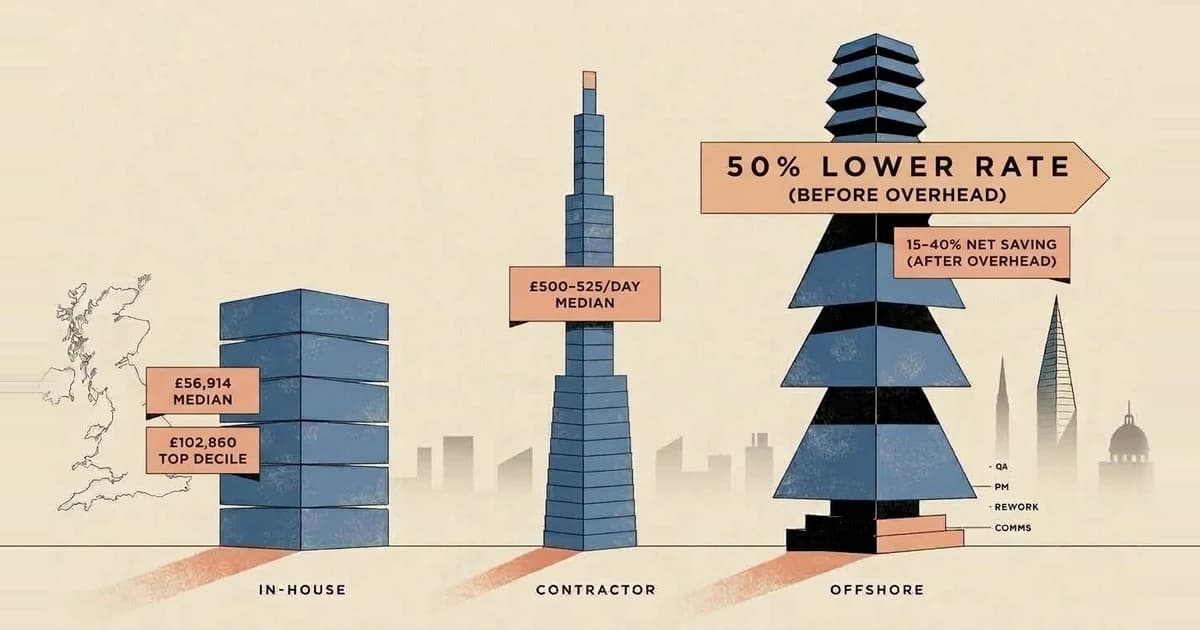
Here is the direct answer. In 2026, the median UK contract day rate is £525 for a Software Developer and £560 for a Software Engineer, with the top 10% of Software Engineer contracts at £750 or more. Specialist and lead roles such as AI Engineer, Cloud Architect and Lead Software Engineer typically sit between £594 and £675 a day. An offshore engineer working through a managed delivery team, rather than a marketplace freelancer, typically bills at 50 to 70% less per hour, though by outsourcing providers’ own estimates the real saving after quality control, project management and time zone friction usually lands closer to 15 to 40%.
That is the whole article in two paragraphs. Everything below explains where those numbers come from, what actually drives them, and where they stop being true. Lost Circle sees both sides of this pricing question directly, since we run delivery with UK based leadership over an offshore engineering team, so we have watched clients budget for both models and watched where each one goes wrong.
What a UK developer actually costs you in 2026
UK contractor day rates have not moved in one direction through 2026. Over the six months to 18 September 2026, the median day rate for “Software Developer” rose 5% year on year to £525, while the median for “Software Engineer” fell 10.4% to £560, both according to IT Jobs Watch. Because IT Jobs Watch runs a rolling six month window, the exact medians shift a little depending on the day the page is pulled, so treat them as the honest current range rather than fixed numbers. They are also market wide medians across all seniority levels and locations, so they undersell what a senior hire actually costs.
Seniority moves the number less than job titles suggest. “Senior Software Developer” contracts carry a median of £475 and “Senior Software Engineer” £525, at or below the general titles rather than above them, while “Lead Software Engineer” roles sit at £675. The wider spread sits inside a single title: the middle half of Software Engineer contracts run from £463 to £669 a day, and the top 10% start at £750, all per IT Jobs Watch over the same six months.
Specialism adds a premium, though a smaller one than the marketing suggests. “AI Engineer” contracts carry a median of £594 a day and “Cloud Architect” £600, around 13 to 14% above the general Software Developer median, while “Machine Learning Engineer” sits at £548 and “DevOps Engineer” at £519, per IT Jobs Watch. A general purpose engineer without a named specialism is still the cheaper hire, not necessarily the safer one, and that gap is one of the first things Lost Circle checks before scoping a build, since it changes which delivery model actually makes sense.
Location still moves the number, though less than it used to. Financial services, defence and professional services clients have shifted back toward hybrid mandates requiring two to three days a week on site, reintroducing a location premium for contractors willing to commute into London, while fully remote roles now compete against a national pool of contractors and often sit at the lower end of the range.
If you are pricing a permanent hire instead of a contractor, use salary as your starting point, not your final number. The median full time salary for programmers and software development professionals is £56,914 a year, with the top 10% earning £102,860 or more, according to the Office for National Statistics Annual Survey of Hours and Earnings, 2025 provisional data. That is before employer National Insurance, equipment, recruitment fees and office overhead are added on top. Industry estimates put the true cost of employing someone in the UK at roughly 25 to 50% above base salary once employer National Insurance, pension, recruitment, onboarding and equipment are counted: Grove HR puts the loaded cost at 1.25 to 1.4 times salary, and Employers Calculator puts the first year at 30 to 50% above salary, falling to 15 to 20% in later years once one off recruitment and setup costs drop away. Most founders underestimate that on cost layer by a wide margin, and it is usually the single biggest gap between the number in a job advert and the number that actually leaves the business account.
Where the rate goes when you hire a contractor
A day rate is not take home pay, and it is not project cost either. Three things sit between the number a contractor quotes and the number that ends up mattering to your budget, and Lost Circle walks new clients through all three before a contract is signed.
IR35 status. Whether an engagement counts as inside or outside IR35 changes a contractor’s effective take home pay by a meaningful margin, which is exactly why inside IR35 roles tend to be priced higher than outside IR35 roles for the same work. This is a compliance question with a legal answer, not a negotiating position, and it is worth getting right before the contract is signed rather than after. We cover this in more depth in our upcoming piece on IR35 and outsourced developers.
Non billable time. A contractor’s day rate has to cover the weeks they are not on a contract, which is part of why contracting pays more per day than the equivalent salaried role once you annualise it.
Project overhead. Planning, architecture review and QA are rarely priced into a headline day rate, which is where budgets quietly grow after the contract starts. This is the single most common reason a quoted rate and a final invoice do not match, and it applies equally whether the contractor is UK based or offshore.
The offshore comparison, with real numbers
Offshore development is not automatically cheap, and the marketing around it does not help you plan a real budget. Here is what the number actually looks like once it is unpacked, and it is the exact calculation Lost Circle runs through with clients weighing a UK contractor against an offshore build.
Start with how thin the independent evidence is. Deloitte’s 2024 Global Outsourcing Survey names cost reduction alongside skilled talent and agility as a key driver for outsourcing, but it does not publish a single savings figure. Most of the numbers in circulation come from outsourcing providers themselves. Dotcode, a software outsourcing company, puts gross savings from offshore labour arbitrage as high as 70%, and net savings after hidden costs at 15 to 40%. The gap between those two figures is the gap between the number a vendor quotes and the number your finance team actually sees at year end.
Those hidden costs are not small. SmartDev, an offshore development firm, estimates that total cost of ownership adds 25 to 150% to base rates once hidden operational costs are counted, which is why a headline 70% saving rarely survives contact with a real project.
For a rough sense of where the money goes on the delivery side rather than the vendor markup, the same guide recommends allocating 15 to 25% of the development budget to testing and QA, and 10 to 15% of the timeline to defining requirements up front, both of which are usually the first things cut when a quote needs to look smaller on paper.
Lost Circle runs delivery with UK based leadership and an offshore engineering team, which is the structure this cost breakdown is describing directly. The saving is real, but it comes from where the team sits, not from cutting the planning and QA stages that keep a project on budget. That distinction is the difference between an offshore saving that holds and one that disappears by month three.
In house vs contractor vs offshore: the decision table
| Row | In house hire | UK contractor | Offshore team, UK led |
|---|---|---|---|
| Typical cost | £56,914 median full time salary, £102,860 at the top decile, plus roughly 25 to 50% in employment on costs | £525 to £560 median a day, £594 to £675 for specialist and lead roles | 50 to 70% lower hourly rate before overhead, 15 to 40% net after it, by outsourcing providers’ own estimates |
| Speed to start | Slowest, recruitment led | Fast, days to weeks | Fast, days to weeks |
| Best for | Long term product ownership, deep institutional knowledge | Short term skills gap, defined scope | Sustained delivery capacity at a lower burn rate |
| Main risk | Fixed cost regardless of workload | IR35 misclassification, rate inflation for scarce skills | Hidden costs, time zone and communication friction if not UK led |
| Question to ask yourself | Will this role exist in two years? | Is the scope genuinely fixed, or will it grow? | Does the vendor lead delivery locally, or hand you an offshore black box? |
Working out what your build should cost?
Get a project quote →What actually drives the final bill
Day rates get the headlines. These are the line items that actually move a project budget once work starts, and the ones Lost Circle’s own project managers flag earliest in a build.
- Scope clarity. Ambiguous requirements and unclear acceptance criteria create disputes that cost more than the planning work that would have prevented them. SmartDev estimates that around 35% of fixed price offshore projects hit scope disputes, with change orders averaging 15 to 25% of the original contract value.
- Team structure. A single freelancer costs less per hour than a managed team, but a managed team often costs less per outcome once project management and QA are accounted for.
- Specialism. As covered above, AI engineering and cloud architecture carry a premium over general purpose engineering, around 13 to 14% on current IT Jobs Watch medians, and lead roles carry more again.
- Engagement length. Short, undefined engagements price in risk. Long term partnerships price in trust, and the rate tends to reflect that over time.
- Location of leadership. An offshore team led locally, with a UK point of accountability, carries a different risk profile and a different price to a fully offshore vendor relationship with no local oversight.
Where offshore does not save you money
Every agency blog claiming success is worth reading with a note of caution, including this one. Offshore delivery is not free of trade offs, and pretending otherwise is exactly how the hidden cost problem above happens in the first place.
Independent research says the same thing. Looi and Szepan surveyed 80 customers of outsourced software development and found that temporal distance works against a project: nearshore teams came out ahead on overall success, quality, schedule, management effort and communication problems. A tertiary study of global software development by Verner and colleagues reaches the same conclusion from the research literature, naming communication and coordination as the recurring risks in distributed teams. Neither says offshore does not work. Both say the coordination overhead is real, and that it has to be budgeted rather than assumed away.
It does not save you money on projects with poorly defined scope. Boehm and Basili’s Software Defect Reduction Top 10 List found that software projects spend about 40 to 50% of their effort on avoidable rework, and that hastily specified requirements are one of its two main sources. Unclear requirements cost the same regardless of where the team sits, and the cost of a misunderstanding travels worse across a time zone gap than across a desk.
It does not save you money if quality assurance gets cut to protect the headline rate. The same work found that finding and fixing a problem after delivery is often 100 times more expensive than finding and fixing it during requirements and design, while noting the factor is closer to 5:1 on small, non critical systems. The multiplier is not universal, and nobody should treat it as one, but the direction holds: defects found late cost more than the QA stage that would have caught them.
And it does not remove the need for compliance review. The Information Commissioner’s Office treats the UK GDPR restricted transfer rules as engaged when personal data is sent to, or made accessible to, a separate legal entity outside the UK, which an offshore engineering partner usually is. Where the off payroll working rules apply, status has to be assessed contract by contract against both the contract terms and the actual working arrangements, and for medium and large private sector clients it is the client who makes that determination and issues the status determination statement. These are separate conversations that have to happen before the contract is signed, not after. We go into this in detail in our upcoming piece on offshore development and UK GDPR.
How Lost Circle prices a project
We do not lead with a day rate, because a day rate on its own tells you nothing about total cost. Lost Circle scopes a project first, prices the team structure that fits it second, and only then puts a number in front of a client.
That usually means a UK led offshore team for sustained builds, since it is where the maths above holds up best over months rather than weeks. For short, tightly scoped work, a UK contractor is sometimes the better fit, and we say so even when it is the smaller invoice for us.
Read more on how Lost Circle structures UK led offshore delivery or see our full case study work.
What this means for your budget
- UK contractor medians in 2026 sit at £525 a day for Software Developer and £560 for Software Engineer, rising to £594 for AI Engineer, £600 for Cloud Architect and £675 for Lead Software Engineer.
- A UK permanent hire costs £56,914 in median full time salary, rising to £102,860 at the top decile, before the roughly 25 to 50% in employment on costs that salary figure never includes, weighted toward the upper end in the first year.
- Offshore development can save 15 to 40% net by outsourcing providers’ own estimates, but the widely quoted 70% figure only holds before hidden costs, rework and time zone friction are accounted for.
- The single biggest driver of budget overrun is unclear scope, not the headline rate you signed at.
- A UK led offshore structure is a different risk profile to a fully offshore vendor relationship, and the two should not be priced or evaluated the same way.
If you are weighing up how to structure a build for 2026, that is exactly the conversation Lost Circle has with clients before any quote gets written.